
Asserting that "maritime muscle flexing" by some countries and other factors have made the Indo-Pacific region "more contested and more volatile," naval chief Admiral Sunil Lanba on Tuesday said that the Indian Navy has its task cut out as it has been a major security provider in the region.
On the first anniversary of the Narendra Modi-led NDA government, Sangh Parivar affiliates say they are annoyed with the ruling dispensation but can't live without it either

Outlining eight "pillars" for the future of India-China relations, President Pranab Mukherjee on Wednesday underlined the need for comprehensively resolving challenges including the boundary question through "political acumen" and "civilisational wisdom".

After Pyongyang tests a missile potentially capable of reaching the US, Dr Rajaram Panda explores the realistic -- and peaceful -- options before Donald Trump and the international community at large.

President Pranab Mukherjee on Monday addressed the first joint sitting of Parliament as mandatorily required under the Constitution after the general elections. The address is the political, economic and foreign policy road map of the Narendra Modi government and covers virtually all crucial areas.

Terrorism and Afghanistan were the focus points of Prime Minister Narendra Modi's talks with Uzbek President Islam Karimov on his first visit to Central Asia.
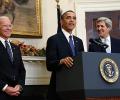
'The threat that India faces and the threat the United States faces is not just to the homeland, but to our people and to our institutions wherever they may be.' In an exclusive conversation with Aziz Haniffa/Rediff.com, US Assistant Secretary of State Nisha Desai Biswal outlines the importance of Prime Minister Modi's visit for America.

'The US wants Modi to succeed because we want India to succeed. For our part, when India thinks of its partners in the world, we want it to think of the US first. That means positioning our country as the preferred provider of the key inputs that can help to propel India's rise.' 'The meeting between Modi and Obama is, and must be, an opportunity for true strategic dialogue -- not a scripted exchange of talking points, but an open discussion of the big questions. What kind of world do we want to live in? What are our true priorities? And most importantly, why does this partnership still matter?'

'The Modi-Xi and Modi-Obama meetings, with an interval of just 12 days, are juxtaposed superbly at a crucial point in the prime minister's life. Can Modi carve out a win-win situation with the superpower and the emerging superpower at the same time?'

The second-longest serving chairman introduced quite a few measures for the primary market and implemented a new corporate governance framework.

Lawmakers were not going to be in town on that particular day, and would be in their constituencies preparing for the mid-term elections in November. Rediff.com's Aziz Haniffa reports
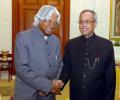
'A President who is a living embodiment of high principles can tone up the entire national fabric,' says B S Raghavan, the distinguished civil servant.

'With Prime Minister Modi's electoral victory, President Obama very quickly reached out, and we were off to the races.' 'We've seen two highly successful leader-level engagements in the past five months. We've really turned things towards a new beginning -- a new energy, a new momentum...'

Accusing the United Progressive Alliance government of "heaping hardships on people," Tamil Nadu Chief Minister J Jayalalithaa flayed its "knee-jerk" reaction of increasing Foreign Direct Investment cap in different sectors and warned that its "insensitivity" towards people will take its toll soon.
The kind of people Narendra Modi has chosen, the decisions he has taken and the rail and central budgets suggests that he is treading carefully in New Delhi. There is less of innovation and more of continuity, so far. He is not ready to rock the boat and start from scratch, says Sheela Bhatt.
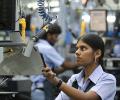
Tax problems and unfavourable WTO agreements are making Tamil Nadu's electronics corridor less attractive to companies.

Recognising the threat posed by outfits like the Al Qaeda, Lashkar-e-Tayiba and the Dawood Ibrahim network, India and the United States have agreed to deepen cooperation in fighting terrorism and asked Pakistan to bring to justice the 2008 Mumbai attack perpetrators.
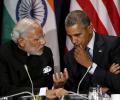
'Big countries do not agree on every set of issues.' 'Look, one of the differences in the relationship is that when we do not agree, we are sitting down and talking to each other.'


Shreekant Sambrani is confident that today's adversity will make the country emerge even stronger
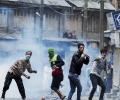
'Burhan Wani's killing served as a spark for the anti-establishment fire that has been raging in the minds of Kashmiris ever since the Centre stopped engaging them for their political future,' says Air Vice Marshal (retd) Kapil Kak in an interview with Rediff.com

I still believe that it is a good thing that think tanks are mushrooming in Delhi. They provide a platform for discussion, even if they shed more heat than light. With Parliament almost incapable of serious debate, informed discussion and civilised discourse, where does this nation get its intellectual churn, asks Mohan Guruswamy.

Here's the full text of Prime Minister Narendra Modi's address to the United States Congress.
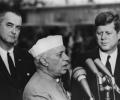
As Prime Minister Narendra Modi begins his historic visit of the United States of America, here's a look at some landmark visits by Indian prime ministers to the United States of America.

Indian economy about to take-off

The journey of Abhijit Avasthi, the former national creative director of Ogilvy & Mather, is as amazing as it is unbelievable. Read on!
